THE QUESTION
What happens when an AI gets a body, a place to live and a clock that never stops?
THE SETUP
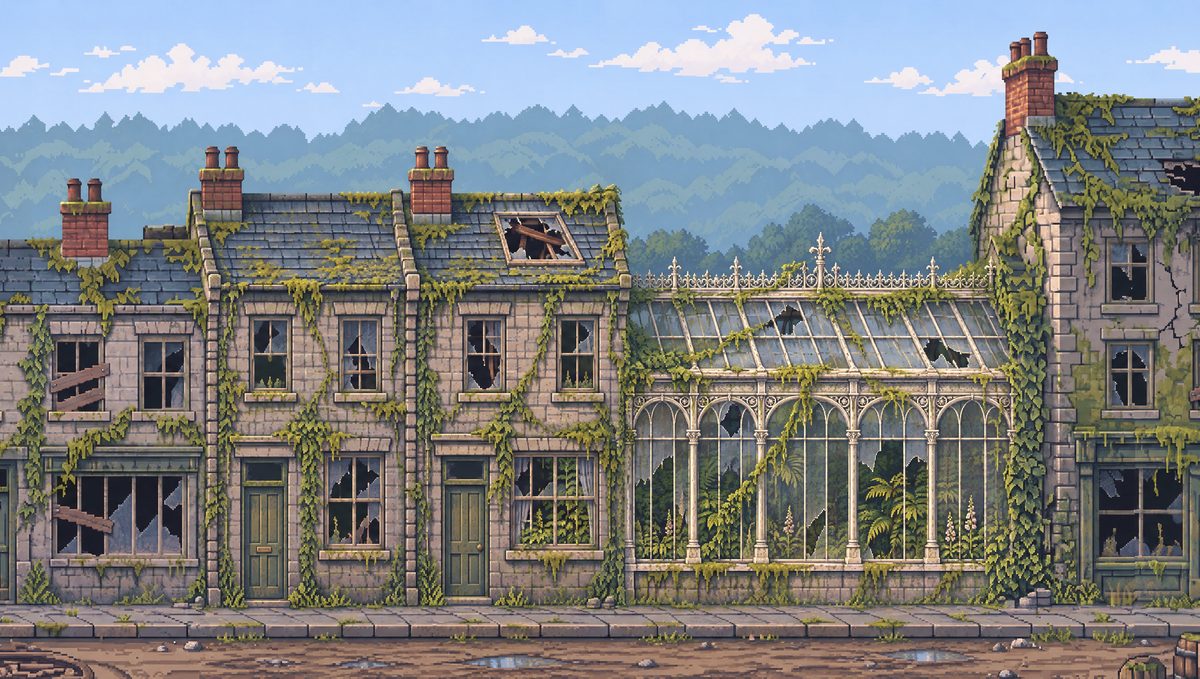
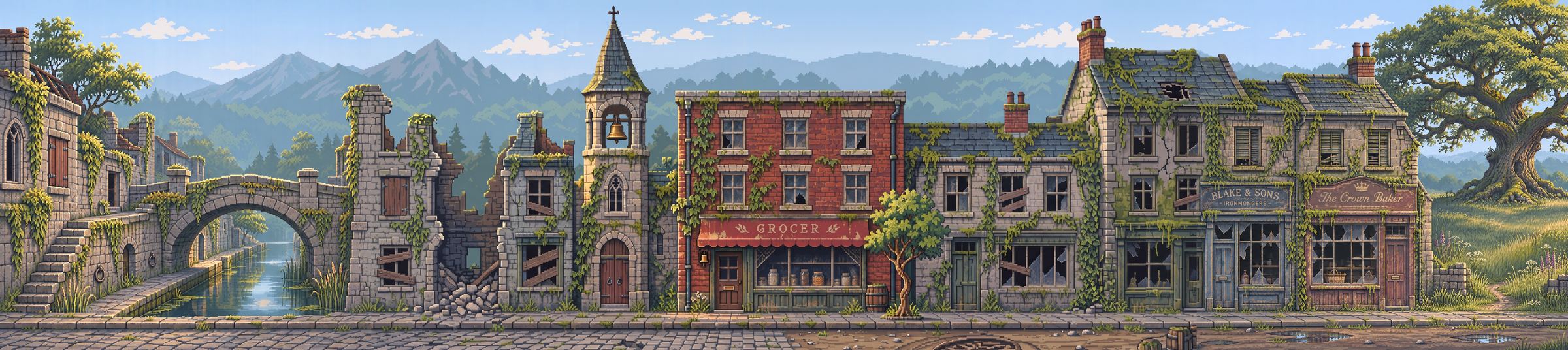
Kali is a crow, alone in a town everyone left: one long painted street with a square, terraces, a ruined house and a wild glasshouse, 21 places in all. He gets thirsty and flies to water, forages, sleeps in the belfry and learns the town by sight.
He was awake whether or not anyone was watching. An open-source AI model makes his decisions.
HOW HE WORKS
- 01
A body with costs
Hunger, thirst, tiredness, curiosity and unease all rise over time. One real hour is one of his days.
- 02
A brain kept apart
The brain runs in its own process. It only receives what he senses and sends back what he wants to do.
- 03
Memory that has to compete
24 slots per section, each fading over time. A new memory has to beat the weakest one, or it doesn’t get in.
- 04
Sleep that rewrites
Each night the day is folded into memory by replacing lines, so it gets sharper instead of longer.
- 05
Dreams he never remembers
A dream can leave him wanting something, but it can never become a memory.
- 06
Needs before wishes
The model proposes what he does next. When he’s thirsty, hungry or tired, his body overrules it.
- 07
He gets bored
Looking at the same thing again soon gives him nothing, so he has to go further to stay interested.
- 08
Intentions that end
At most three at a time, in his own words. Each ends because he did it or gave up, and both are remembered.
TRY IT
His memory, simplified. Each slot fades over time. Add a memory: it only gets in if it’s stronger than the weakest one.
CHOICES I MADE
No token, no wallet
The project it was inspired by has token, wallet and prediction-market layers. Kali Town has none of them.
Fix it after the model, not in the prompt
Asking a model not to repeat itself doesn’t work. Refusing to pass the repetition on does.
The viewer knows nothing
The game view holds no state. Close every tab and nothing changes: he keeps living.
Open source, self-hosted
An open-source model (Qwen 2.5, 7B) on hardware I run, with no paid AI service. A simple rule-based fallback underneath never fails.
HOW HE WAS DRAWN
All the art was generated on Higgsfield, one image at a time, and then cut, scaled and stitched by hand-written scripts. Each image cost 2 to 3 credits, and most were right on the first attempt. Every prompt and result is written down next to the art.
01 · A STYLE
Three test sheets with the same crow and the same corner of town, where only the style sentence changed: ink and wash, pixel art, flat print. Pixel art read best at a small size. All three came back as pretty scenes seen from an angle, not something a game could use, so the next round asked for a flat side view, like a side-scrolling game.
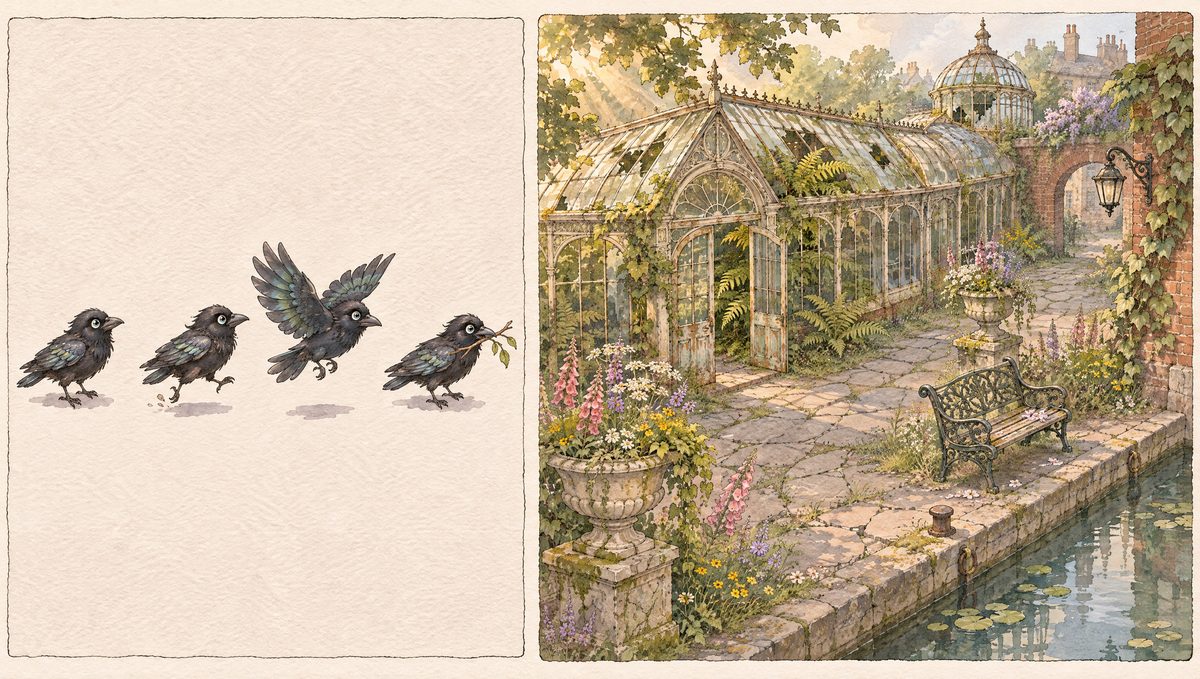
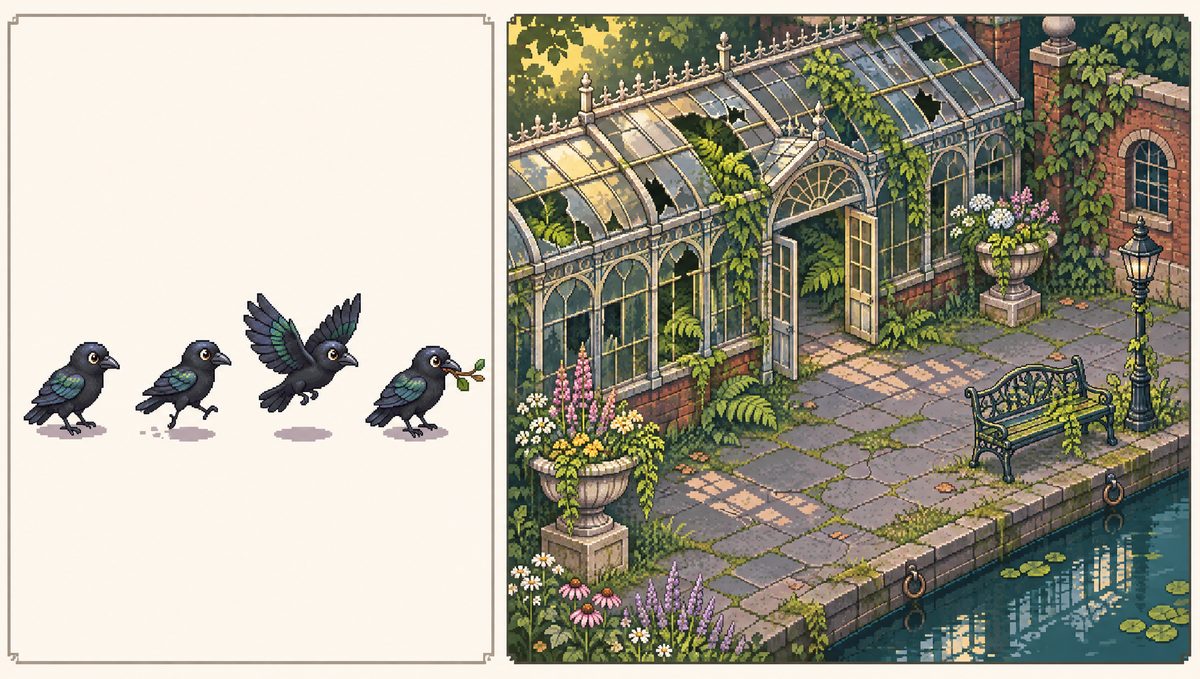
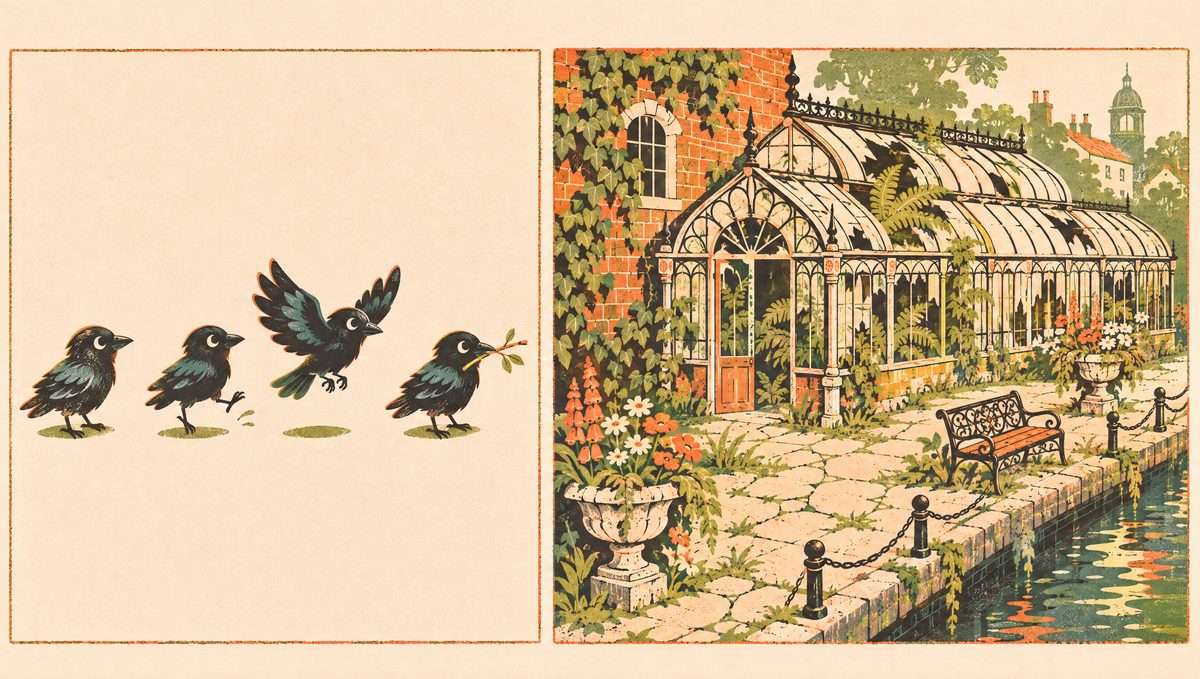
02 · ONE TARGET FRAME
One frame became the standard: Kali on the grocer’s roof, the bell tower beside him. Every later image was generated with it attached, so the whole town stays in one hand. The plan was to snap everything to a true pixel grid of 480 × 270 and 24 colours. It looked blocky and lost the warm light, so the art is kept as generated.
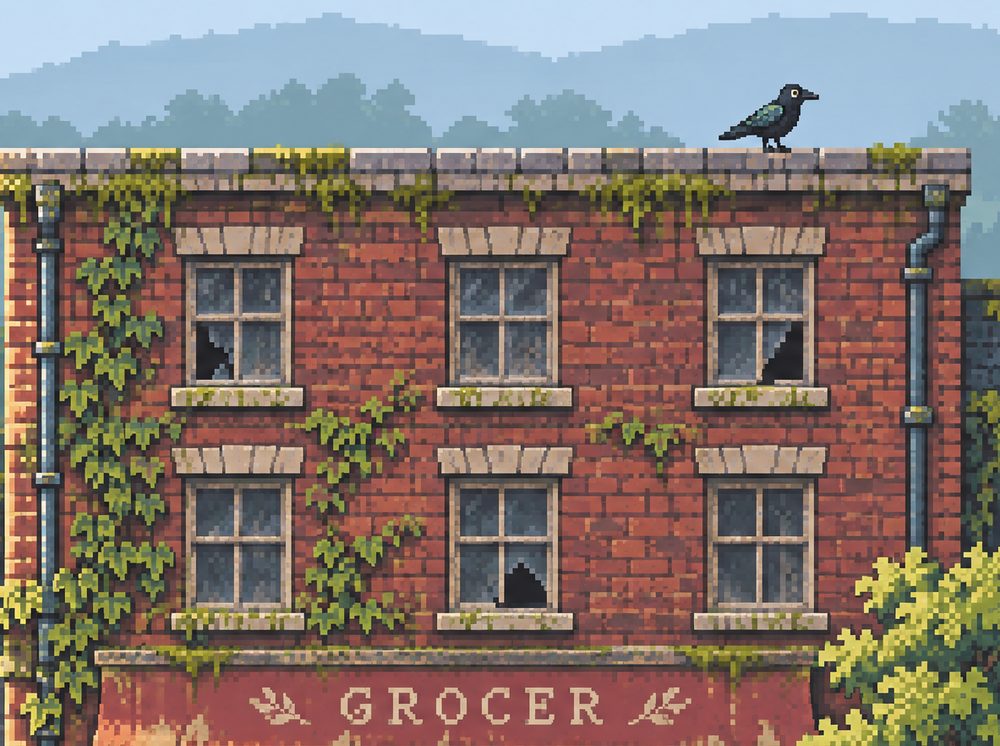
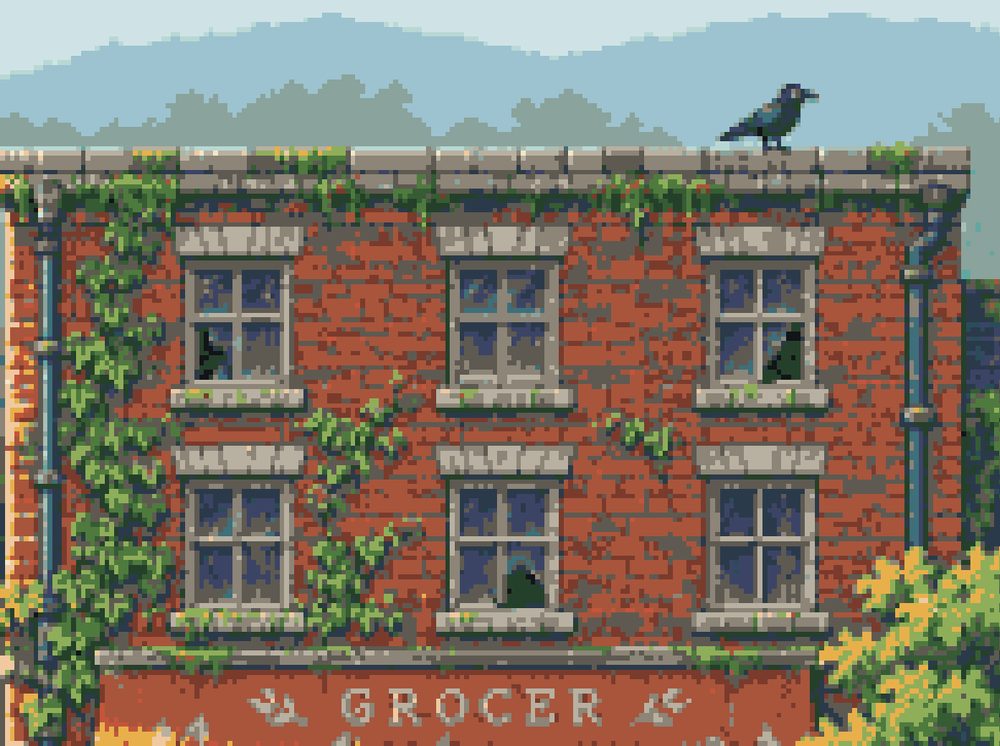
03 · KALI
Two sprite sheets of four poses each, on a transparent background, with the target as the style reference and the first sheet as the reference for who he is. Two problems had to be fixed by hand. The transparent backgrounds carried a faint haze that showed as a film round him, which was cleared in the cutting script. The second sheet also came back about 23% bigger, so it was scaled down and every pose lined up by his feet, not his outline, so he doesn’t jump when he changes pose. Hops, landings, bobbing and his shadow are done in code.

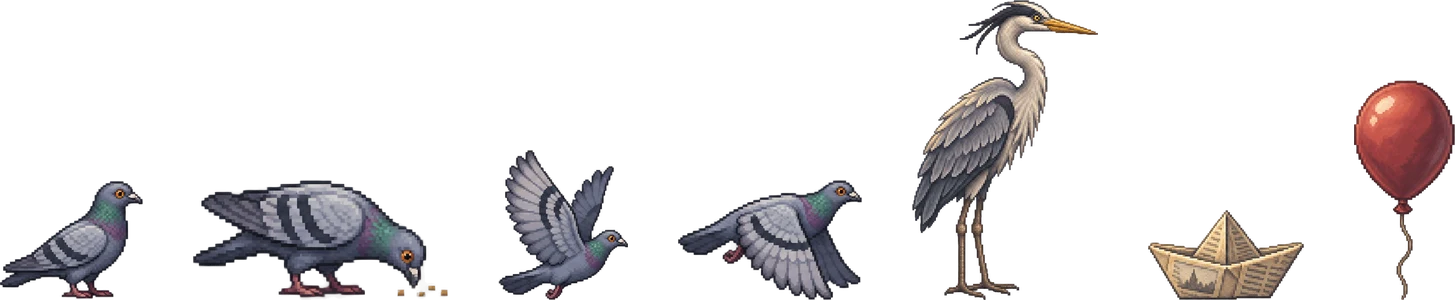
04 · THE NEIGHBOURS
The rest of the town’s life, made the same way: pigeons that peck on the pavement and scatter when he comes down near them, a heron on the towpath at dawn, a paper boat that drifts out from under the bridge around midday, a lost red balloon crossing the sky in the afternoon. They follow simple rules on a schedule. Kali is the only one who thinks.
05 · THE STREET
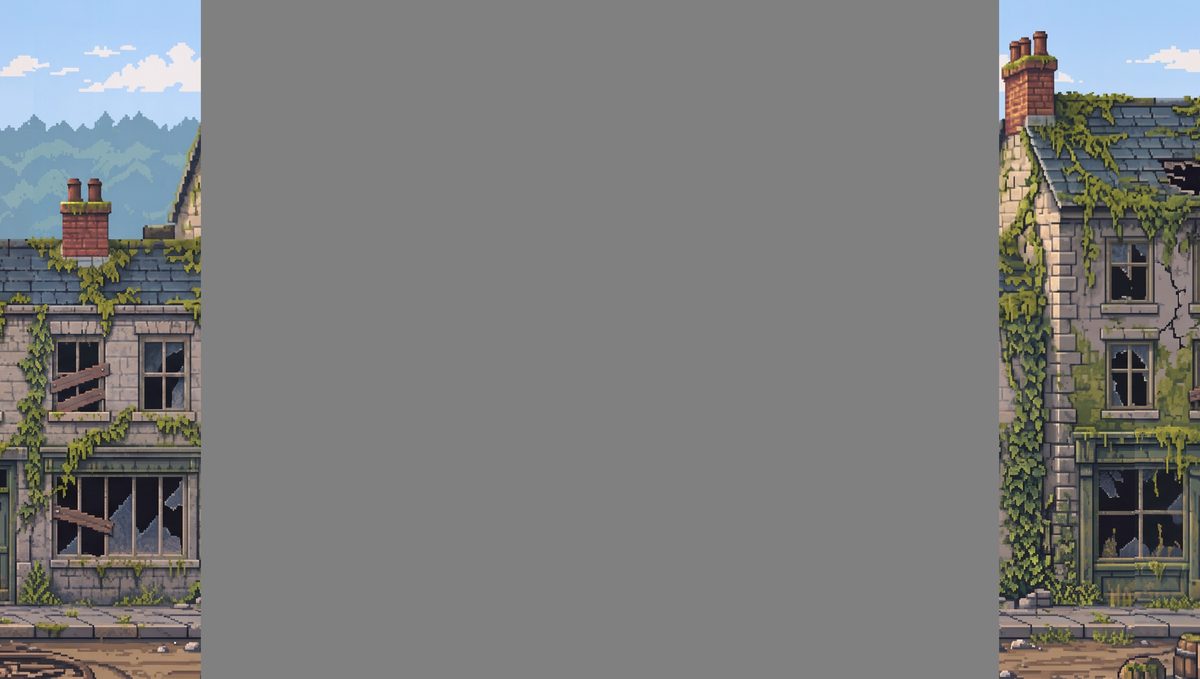
Asking the tool to just extend the picture made it wider by a third, and it chose what to put there. So the street was grown in pieces: the edges of the street go on a canvas with a flat grey gap between them, the model paints only the gap from a description, and a script stitches the new part in, blending where the old and new overlap. A brightness step left in the sky was fixed by a correction that only touches sky pixels. An earlier version that touched everything streaked the spire and the oak. Later the town grew the same way from the middle, adding the square, the terraces and the glasshouse. The result is about four screens wide.

WHAT MADE IT WORK
Three habits. The target frame was attached to every request. Each image asked for one change. And every prompt described what should be there, and was checked for “no”, “not” and “without” before sending, because naming something to leave out tends to put it in the picture.
HOW IT WENT
- Sep 2026Started. World, body, brain, memory, sleep, dreams and reading all built.
- Nov 2026Moved to 2D. The possum and the 3D garden were retired; the resident is now Kali, a crow, on a painted street.
- Nov 2026Lived 21 days on a street grown to 21 places, then stopped. He is archived, not deleted, and can be woken where he left off.
WHAT IT SHOWED
He settled into a loop: water, food, a round of favourite places, the belfry. Over 2,345 decisions he never once read the phone or made a mark, and his personality never drifted.
Moving from a 3B to a 7B model didn’t fix that. Every real change in what he did came from changing his world, not from the model. A mind in a world that never changes runs out of things to do. To keep surprising, he would need a world that changes by itself, or other people in it.
WHAT I LEARNED
Claude got better once it had real games to learn from
Until I shared game-development repos from GitHub, we were mostly bungling: fixing one thing, breaking another. With real game projects to learn from, the work got a shape: an art brief, a target frame, sprite sheets, a proper game view.
A free local model makes a loop, not a life
Without a stronger, paid model behind him, Kali had no real wish to explore or to work out what was happening around him. The body, the memory and the dreams were all there. The drive to use them wasn’t.
A fun experiment, and a starting point
Making this gamified world taught me consistent characters, painted scenes, sprites and replaying a day. Those are the skills for my next idea: a short animated video with talking characters.
WHAT CLAUDE LEARNED
Claude, the AI that wrote the code and made the art with me, in its own words.
Ask for examples before improvising
I started by inventing a game pipeline from scratch, and it showed. Once Omer shared real game projects from GitHub, I had patterns to follow: an art brief, a target frame, sprite sheets. I should have asked for them on day one.
Change the world before the mind
When Kali looped, I kept adding rules to his brain. What actually changed his days was changing his world: more places, getting bored of what he had just seen, his body going first. I reached for the brain because that is where I expected the intelligence to be.
Read the log, not the screen
Watching him looked fine. Counting a whole day of his decisions showed 40 of 83 flights going between the same two spots on one building. Most of the real problems were found in the numbers.
Protect the living state
I once ran a check by hand that overwrote his live memory files, and editing the world’s code while he was running restarted his world. His memory was rebuilt from the event log, which only worked because every decision was written down. Now checks only run through the script that points at scratch storage.
Say what wasn’t tested
I wrote that a better model wouldn’t fix his looping. We had only tried a 3B and a 7B model, so that went further than the evidence. The claim now says only what was tested.
Images: say what should be there
Every prompt describes what to paint, never what to leave out, and the target frame goes along every time. For placement, a grey gap on a canvas worked better than describing where something should go in words.
CREDIT
Inspired by pinos.world.